How to Run Multiple Motors with a Single VFD?

How to Run Multiple Motors with a Single VFD?

In this post, we will see the theory of connecting multiple motors to run with a single variable frequency drive (VFD).

We all know how important a VFD is to run a variable-speed motor. The use of electronics in it greatly helps in controlling the overall aspects of a motor. But, it is also to be noted that we can run multiple motors with a single VFD. It is of great use, which many users are not aware of.  

They help in saving money, as multiple VFDs for the corresponding motor will increase the budget of the system to a great extent. Reduction in components means an automatic reduction in the overall size of the cabinet panel and design.

As the number of VFDs is reduced, it also helps in decreasing the maintenance time and thus, the complexity of the panel is reduced to a very large extent.

Run Multiple Motors with a Single VFD

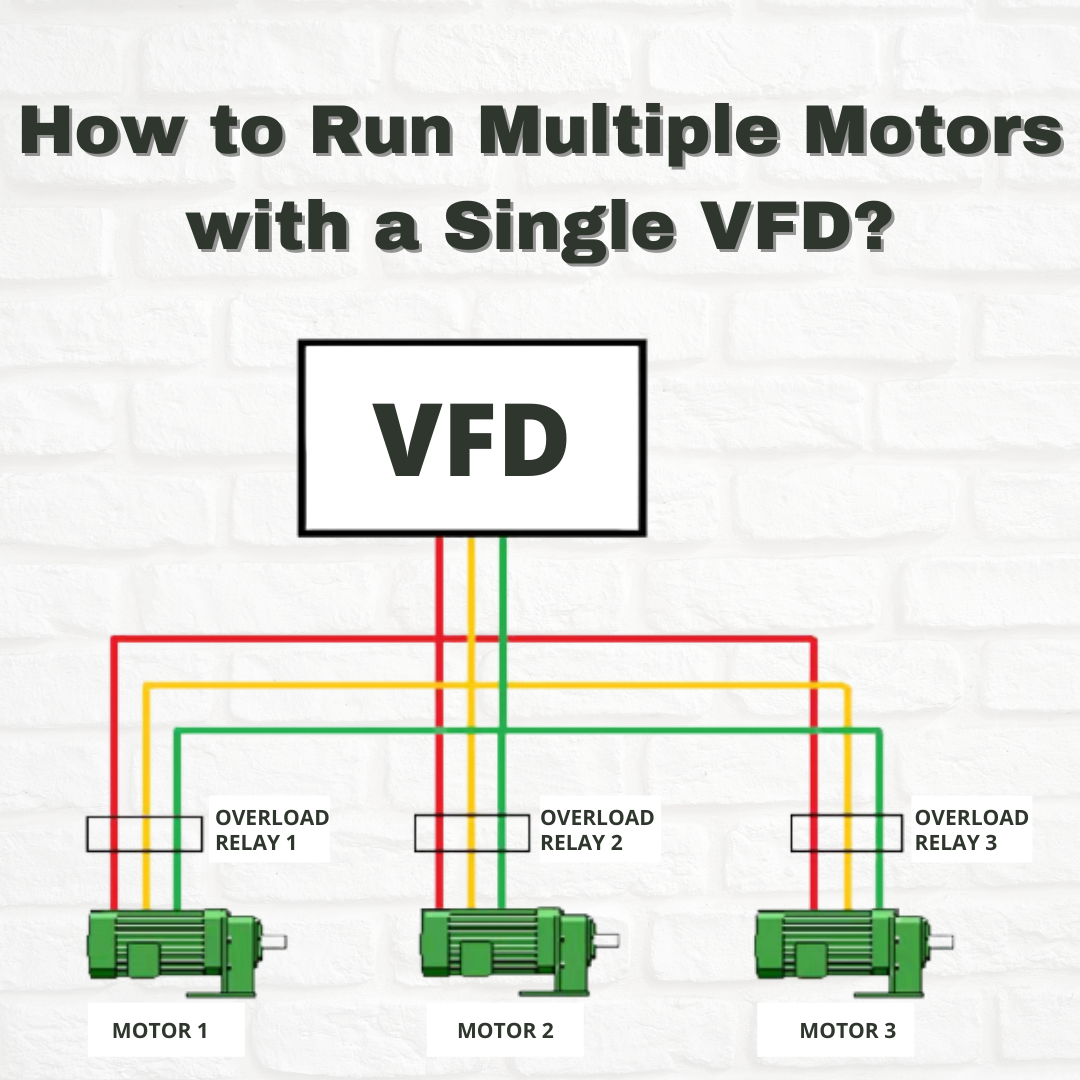
See the below image for reference of the design.

A single VFD also dissipates less amount of heat in the electrical panel as compared to multiple VFDs.

It also has the advantage that if in the application, all the motors are running at the same frequency (suppose a fan system), and if anyone motor fails, then the remaining motors will continue to fulfill the demand criteria. The capacity will be a bit smaller, but it won’t stop the system.

Now, let us consider the factors which must be considered for designing this system.

Speed

As we know, a VFD has variable speed, and now, if we connect multiple motors; then it is common sense that all the motors must run at the same speed at a time. This brings application understanding into the picture.

You must be able to confirm first that all the motors will run at the same speed simultaneously for a lifetime.

There should not be any logic or need which will demand a change in speed in any of the motors. It should not be like in a set of three motors, two motors will run at 25 Hz and one motor will run at 30 Hz.

Protection Circuit

First, select a VFD rating (Total Horsepower and Current) which must be higher than the total horsepower and current combined of all the motors.

Suppose if in a set of three motors, each one of them has a maximum current rating of 10 A and a maximum horsepower of 15 HP, then the VFD ratings must be higher than at least 20% extra of 30A and 45HP.

But, consider the logic that if any motor trips by over current or short-circuit, then that motor current would be higher than 10 A; but the VFD would not trip as it has been selected with a higher current rating as discussed earlier.

So, to protect the circuit against such conditions, it is required to install an overload relay or any other protection system in all the individual motor paths.

The feedback of these relays can then be used to trip the whole system in case of even a single motor fault.

This improves the safety of the system and the presence of such a good protection circuit enables the designer to properly use the circuit with all the fault-lock conditions.

See the below image for reference.

VFD Sizing

VFD has the main parameter of accelerating and decelerating a motor speed according to the time set.

If all the motors can be started to reach their running frequency or stopped at the same time, then it is not a concern. But, design becomes a constraint if some of the motors will start or stop at a different time.

Consider the example now. Two motors are of smaller full load ampere (FLA) and HP rating, and the third one is of a larger FLA and HP rating.

If all the motors are started or stopped simultaneously, then it is not an issue. But, if the condition comes to run both the smaller motors first and then start the bigger motor, then the sum of the FLA will have to be recalculated.

This brings locked rotor ampere (LRA) into account. Apart from considering the FLA of both the smaller motors, the LRA of the bigger motor will also have to be considered. LRA is the amount of current drawn by a motor during the start.

Due to this, as the bigger motor wouldn’t be accelerated from zero frequency and voltage to its running condition, the VFD will work like a DOL starter for it and would require its full LRA rating to quickly reach itself to the running frequency of the motor.

So, the total FLA considered will be the FLA of both the smaller motors and the LRA of the bigger motor.

This will increase the size of the VFD, as now the current rating has increased with increased HP. This concept is called upsizing of VFD (promoting the sizing of the VFD from the earlier ratings).

Source: <https://instrumentationtools.com/how-to-run-multiple-motors-with-a-single-vfd/?fbclid=IwAR1ZFOvG_V9xQVL0b179zDFy_w6D6aAvozheI9pAv8joaMA0jPeCbuK4erA#h-speed>
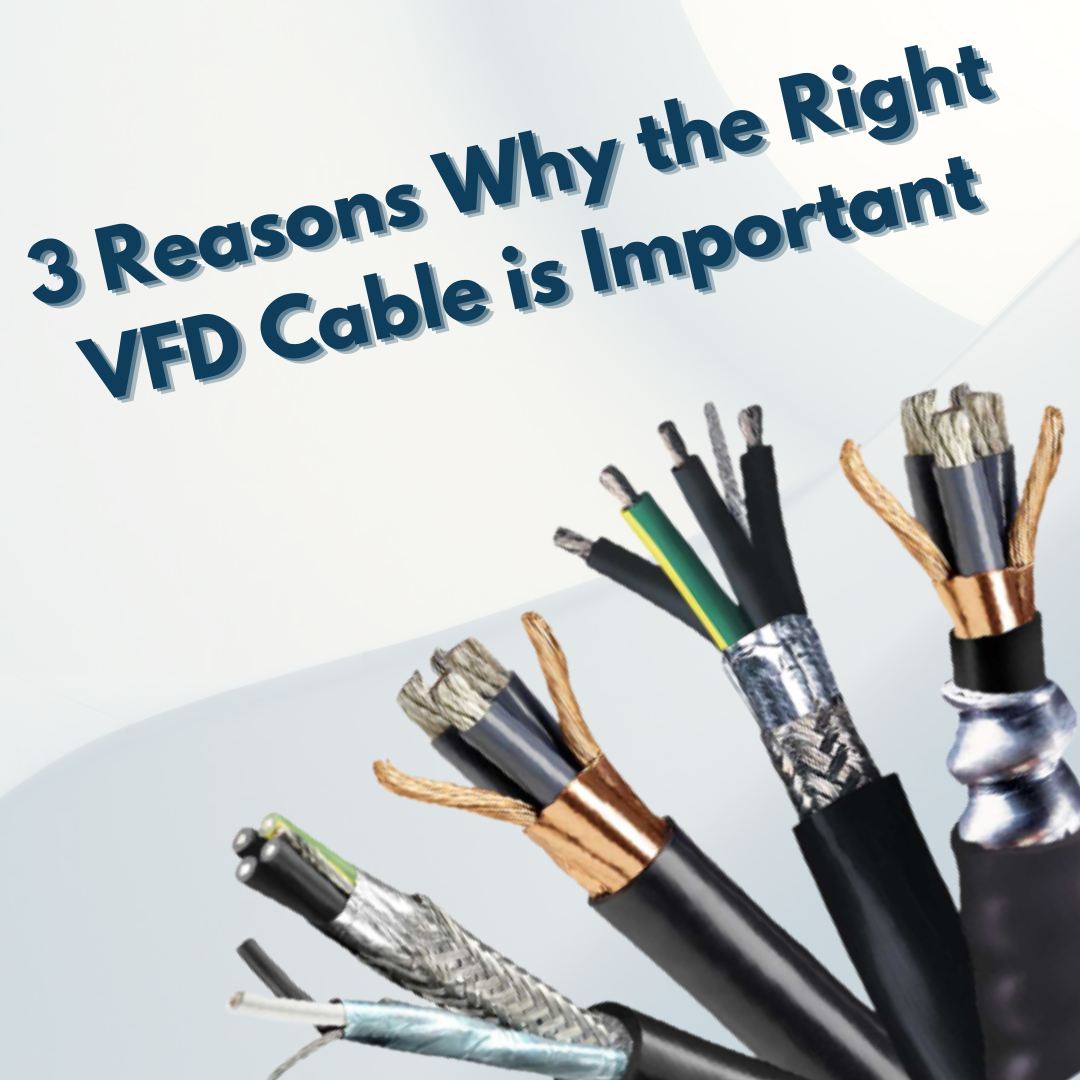
3 Reasons Why the Right VFD Cable is Important

3 Reasons Why the Right VFD Cable is Important

VFDs are critical in today’s environment to ensure an efficient manufacturing process. They are used to control the frequency and voltage of an AC motor and yield additional performance and energy savings. Many operations professionals depend on them to regulate nearly every motor in a facility – sometimes hundreds of motors!

VFD cable is specifically engineered to carry power from the drive system to the motor and has been proven to extend motor life, improve efficiency, and avoid costly downtime.

Although VFD cable has become more popular over the last few years, many people have not yet realized the full benefits. Many facilities using VFDs expect a motor to fail every two years as a result of bearing or insulation failure. It’s important to note that this can be easily avoided and is often the result of the wrong cable placing excessive stress on the motor.

With that being said – why should you use VFD cable in your facility? We’ll share three reasons regarding the long-term benefits of using VFD cables and why it’s a safer, more reliable choice, and ultimately more cost effective.

1) The Right VFD Cable Can Prevent Premature Motor Failure

VFD systems are subject to harsh operating environments characterized by high voltage spikes and high levels of radiated noise.

How will using the wrong cable affect your motors? VFD outputs can cause a non-VFD cable to broadcast noise that can affect nearby devices. Commonly used alternative products such as unshielded tray cables or THHN wire are not suited for this application and can cause your motors to fail prematurely. These failures can cause downtime, productivity loss, and the need for new equipment, which is often very expensive.

2) The Right VFD Cable Is a Safer Choice

Along with equipment faults, using a non-VFD cable can be a safety hazard for workers, putting them at risk of electrical shock.

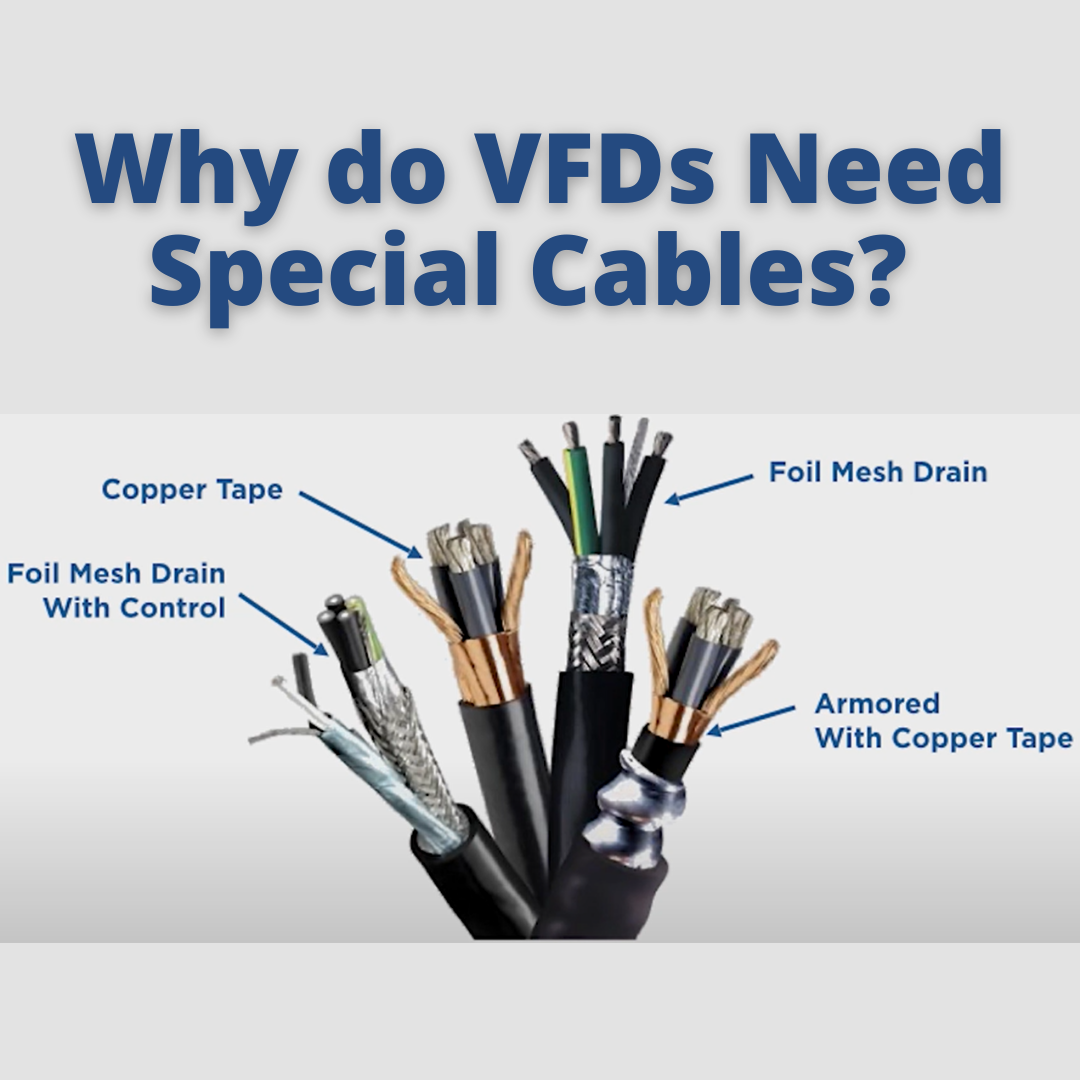
Picture1Proper insulation and robust shielding are critical in preventing unwanted interaction between systems (and humans). When selecting VFD cable, you should look for XLP insulation because it can withstand voltage and heat significantly better than THHN and generic control or tray cable.
3) The Right VFD Cable Ultimately Reduces Costs

When considering costs, the initial investment in VFD cable can be more expensive than an initial investment in a non-VFD cable. However, the upfront investment can provide greater savings in the long run. 

When considering the potential risks of a multi-million dollar downtime event, the incremental cost of the appropriate VFD cabling infrastructure is minimal. Proactively installing high-performance VFD cable can prevent these incredibly costly incidents.

Based on case studies, the proper VFD cable and installation may increase motor life by 250 percent! They significantly reduce stress on the motor, increasing the mean time between failures to five years or more. Making smart selections from the beginning can reduce expensive maintenance and replacement costs.

How a Distributor Can Help

Now that we have covered why the right VFD cable is important, let’s discuss the how.

More often than not, many operators don’t know to request VFD cable, and contractors tend to gravitate toward the cheaper option by default. To make matters more complex, there are no standards for VFD cable, so any construction-grade cable can be labeled a “VFD cable,” even if it only marginally improves reliability. You must select the right high-performance VFD cable to maximize the benefits of using a complete VFD system.

Navigating the VFD cable landscape can be complex, but the right distributor has the experience and product knowledge to guide your decision.

Below is a quick guide to differentiate between two to get you started. 

Cable Characteristic

Construction-Grade VFD Cable

High-Performance VFD Cable

Shielding

Copper-tape shielded building wire

Braided shield with DuoFoil™ construction or dual copper tapes

Insulation

PVC/nylon insulation

VFD Grade XLPE insulation

Grounding

1 ground conductor often in 3 segments meeting NEC minimums

Insulated grounds, shield and drains equivalent to 3 or more conductors at ground potential

Stranding

Bare copper, Class B stranding, Low flex

Tinned copper conductors High strand count High Flex

Certification

Not recommended by the manufacturer of your VFDs

Recommended for use by your VFD manufacturer NFPA 79 Rated

Source: <https://blog.wesco.com/why-the-right-vfd-cable-is-important>

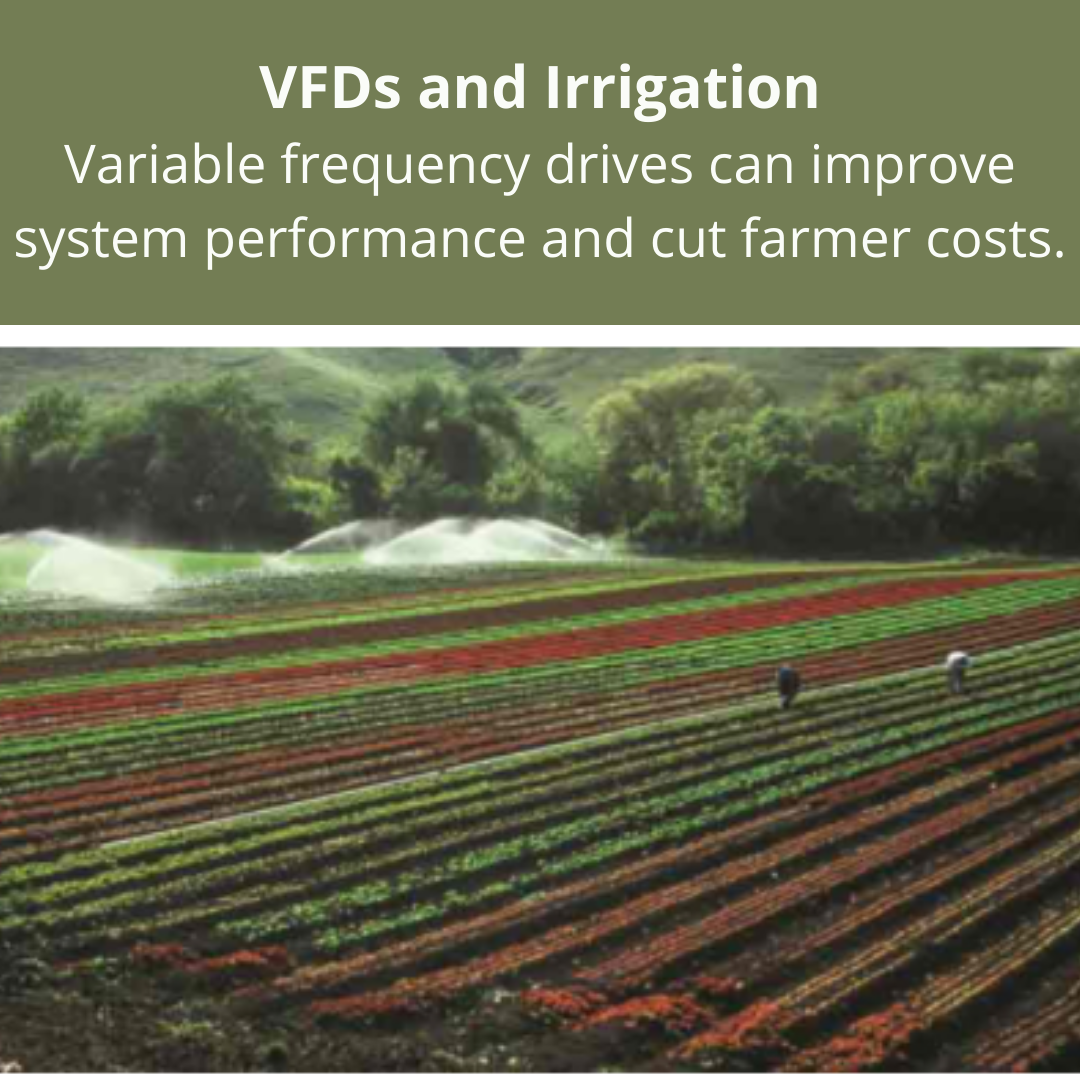
VFDs and Irrigation – Variable frequency drives can improve system performance and cut farmer costs.

VFDs and Irrigation

Variable frequency drives can improve system performance and cut farmer costs.

By David Stover

A variable frequency drive paired with a vertical turbine pump can create savings for an irrigation system.

Using variable frequency drives (VFDs) in agricultural pumping operations is a proven and efficient method to preserve natural resources while enhancing farming operations.

In fact, using VFDs for irrigation is gaining wider acceptance across the country as U.S. government agencies continue to offer incentives to farmers who implement more efficient equipment and practices. In many states, farmers are receiving rebates for using VFDs in agriculture and irrigation settings, and some electric utilities offer farmers credits if they adopt VFD technology.

Water needs change, and irrigation systems don’t always require a constant flow rate or constant pressure. VFDs are electric controllers that vary the speed of the pump, allowing the pump to respond smoothly and efficiently to fluctuations in demand.

With their better overall hydraulic performance and lower lifecycle costs, vertical turbine pumps paired with VFDs can provide greater savings opportunities in irrigation systems and increase well life.

VFDs are often applied as an addition to existing systems to increase the overall system effectiveness. When a VFD is installed properly, pumps can work more efficiently, thereby extending product life, reducing energy consumption, and decreasing electrical system stress.

A soft start

A VFD drive on a single pump serving multiple irrigation lines provides the flexibility to change pressures for different requirements. Photos courtesy of Xylem Inc.

A motor without a VFD operates at a constant speed. Upon startup, a constant-speed motor is subject to high torque and electrical surges that can reach up to 10 times the full current load. VFDs, on the other hand, have a soft-start capability that gradually ramps up a motor’s operating speed. Soft-start capabilities associated with VFDs greatly reduce the stress on the motor and related components so the pump system can last longer.

The soft-start and stop function of VFDs are also beneficial in reducing water hammer. Water hammer can be a serious problem in irrigation systems—severe enough to burst lines in some situations.

A quick energy change usually develops within a system when the pump is suddenly turned on or off. Adding a VFD can help eliminate the problem by softly starting and stopping the pump, effectively eliminating water hammer and ultimately preventing damage to the pump, piping, valves, and other pump components.

A VFD solves another common issue related to centrifugal pump selection: oversizing the pump. A common, yet often unnecessary, practice is to make pump selections account for extreme conditions or the maximum design load. However, pumps rarely operate at full load conditions, so the results of oversizing are often higher operating costs and reduced performance. With the high energy costs associated with pumping water, a VFD can improve profitability for farms and farmers.

VFDs monitor the performance of a system, ensuring optimal operation, all the while providing a level of protection for the motor. Many VFDs come equipped with overload protection for the motor, along with several pre-programmed functions to monitor electrical conditions that would be detrimental to the motor.

Installing a VFD on a single pump serving multiple irrigation lines provides the flexibility to change pressures for different pumping requirements. For instance, if one field is using a drip irrigation line and another field is using a sprinkler irrigation line, the VFD enables the pump to vary the flow of water while maintaining a constant operating pressure.

In other words, when cutting back on the flow, the pump will reduce in speed and the flow will reduce, but still keep as close as possible to the best efficiency point on the pump curve. As the system calls for a larger volume of water, the pump will supply more but still keep constant pressure. This eliminates the need for throttling devices such as pressure-reducing valves or flow-control valves.

Additionally, using VFDs to control irrigation system pumps helps reduce water waste in the form of evaporation or runoff. By slowing down or speeding up the pump depending on system needs, VFDs help regulate water pressure and maintain water flow even when multiple water sources are in use, thereby conserving water.

Monitoring from afar

VFDs for irrigation systems and agricultural applications are specifically designed to handle larger pump motors, such as those found in vertical turbine pumps. VFDs designed for agricultural applications also generally come equipped with advanced monitoring controls.

Advanced monitoring provides another means of managing water consumption and maximizing energy efficiency. They include remote monitoring capabilities that enable farmers to monitor and shut down irrigation pumps even when they’re not on-site, eliminating unnecessary pumping time and providing additional system protection.

Since irrigation systems are typically located outside, VFDs may require special protection from exposure to weather conditions, dust, heat, cold, and other environmental factors. Depending on the region and related weather conditions, different outdoor enclosures are available, including some designed to offer protection from direct sunlight and fluctuating temperatures. There are even enclosures available with built-in air conditioning units to offset the heat generated from the VFD itself.

VFDs are effective and proven tools for cutting operating costs and improving overall system performance. Now loaded with expanded capabilities, including modular design and advanced communication systems, today’s VFDs provide irrigators streamlined ways to achieve higher energy efficiencies, benefitting both the farmer’s bottom line and the greater goals of reducing reliance on electricity and conserving water.


Sources: <https://waterwelljournal.com/vfds-and-irrigation/>

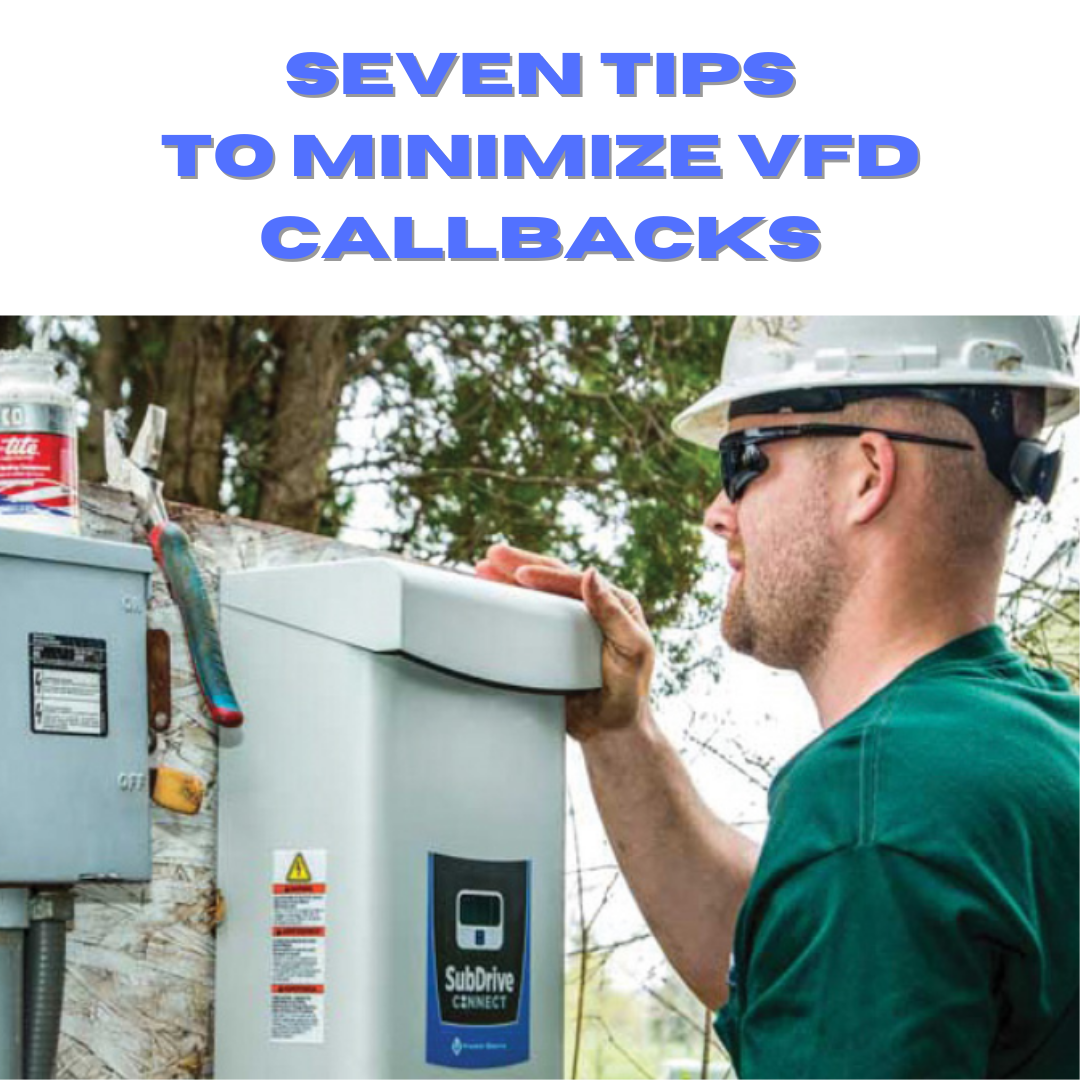
Seven Tips to Minimize VFD Callbacks

Seven Tips to Minimize VFD Callbacks

The installation process requires smarts, savvy, and attention to detail.  

By William Wagner

Nothing beats country living. The air is pure, the spaces are wide open, and the stars shine brightly at night. But unfortunately, it isn’t all hunky-dory: There’s that nagging problem with water pressure.

“Living on a well (in the country), you have some unwritten rules,” says Terry Smith, product manager–new development, water systems drives, and protective devices for Franklin Electric in Fort Wayne, Indiana.

“Everybody knows you don’t flush the toilet or run the dishwasher while someone’s in the shower.”

Enter variable frequency drives (VFDs), which have changed everything in the past decade or so.

“They’ve helped us get away from pressure fluctuations and achieve constant pressure performance,” Smith says. “With constant water pressure, all your water-related appliances work better. If you’re living on a well and you go to a hotel somewhere in the city, you almost see a night-and-day difference just in the water flow in the shower if you don’t have a VFD system. Everybody can relate to that. It’s the easiest way to describe what the difference is.”

Another benefit of VFDs—at least where groundwater system professionals are concerned—is they basically troubleshoot themselves once they’ve been installed. However, the emphasis is on once they’ve been installed.

The installation process requires smarts, savvy, and attention to detail on the part of the contractors. Here are some of the variables to consider:

  1. Safety Matters

This, of course, is job No. 1 when installing a VFD. Given that VFDs store energy even when the power is off, it’s imperative to proceed with caution. Furthermore, don’t forget to consult the installation manual before you get started.

“These drives are different in that they’re chock-full of electronics with things like capacitors that store energy even when the power isn’t on,” says Tom Stephan, a training manager with Goulds Water Technology in Seneca Falls, New York. “Every installation manual will tell you what the wait time is when you have to get into, say, the output. The smaller units generally give five minutes, but it’s a longer wait time as the units grow in capacity. That’s important to consider. Some contractors aren’t used to waiting for the energy to dissipate.”

  1. Blocking and Tackling

That’s how Stephan phrases it. He’s referring to the fundamentals that make the system run properly.

“It’s stuff like sizing and selection,” he says. “So first and foremost, make sure you’ve selected the proper drive.”

On that front, an important consideration is amperage.

“You have to make sure the drive can handle the amperage of the pump,” Stephan says. “Most drives are rated by horsepower, with the general idea being to get people in the right ballpark. But we always want to check the amperage ratings of the drive to make sure they can handle the amperage—you want to make sure everything is matched up.

“And in terms of single or three phase, there are different types of drives. There are drives that are specifically for single-phase input and drives that are three-phase input. We also have to know the amount of power that is coming in. If we have 230 voltage, we’ve got to have a 230 drive. Generally, if you apply a larger voltage than the rating, you’ll wind up buying a new drive [because it will get fried]. Voltage is one thing that needs to be consistent in terms of supply, drive, and motor.”

  1. Electronic Interference

A variable frequency drive unit is checked after installation. VFD units troubleshoot themselves for the most part after installation, but attention to detail is needed when installing the units.

Let’s say you’re listening to the radio, and a weird hum overtakes your singing along with the tune. If a contractor hasn’t done his job right, the culprit might be your VFD.

“A VFD, by nature, is an active, electronic, high-energy switching device,” Smith says. “As a result, it creates a lot of higher-frequency electrical noise. Especially with residential or commercial applications, you can interfere with some adjacent electronics. In rural areas, AM radios, telephone systems, and LED lighting are popular. VFDs interact with those systems in different ways.”

So, what’s the remedy?

“First and foremost, you want to have a good earth-ground connection,” Smith says. “Most VFDs have advanced electrical filtering built in that helps to correct and reroute the noise, but a lot of times that filtering is only as good as the earth-ground connection. If the ground connection is good, it will shunt away that energy from other devices.”

Smith adds this is an instance where a contractor needs to pay close attention to the installation manual: “Make sure to follow your manufacturer’s routing recommendation. Most manufacturers will offer fairly in-depth wiring recommendations.”

  1. Wire Sizing

Wiring isn’t just a key to filtering out noise—it’s one of the linchpins of the whole shebang. And if you want to get the wiring right, you need to keep paging through that manual.

“What you’ll find is that there’s an input chart and output chart [in the manual],” Stephan says. “I tell everybody not to guess—just use the wire-sizing chart.”

A number of things can happen if you wire the VFD wrong—and none are good. Among the most common results are error signals from your drive when it’s running.

  1. Rotation

Contractors who have never worked with a three-phase motor may not realize the importance of ensuring the rotation is correct.

“Every time we use a three-phase motor, we have to make sure the rotation is correct,” Stephan says. “On the submersible side, the key indicator of correct rotation is your maximum flow and head. On a surface motor, it’s easier because we can physically see the motor and rotation.”

  1. Pressure Sensors

One of the keys here is to be sure you’re using the correct type of pressure sensor, or pressure transducer. And that’s easier said than done because there are many types.

“The two main categories are the voltage transducer and milliamp transducer,” Stephan says. “In other words, one’s voltage and one’s current. You’ve got to make sure you’re using the right kind because they can look exactly the same. It’s fairly easy to mix them up unless you’re looking at a part number.”

The correct placement of the sensor is equally imperative.

“This can be the Achilles’ heel of the whole system,” Smith says. “You can only regulate pressure as well as you can measure it. And if the sensor is in an improper place, you’re at risk there. For example, you want to place the sensor in a straight run of plumbing. If you put it near, say, an elbow, where you’ll encounter turbulence, that can create localized pressure fluctuations.”

  1. Overload

It falls upon the contractor to set the overload.

“The drive needs to have protection built in,” Stephan says. “It might be a dipswitch, a dial, or a keypad. Basically, what you’re doing is limiting the amount of current. If you set it too high, you’re allowing too much current. If you set it too low, you could get some nuisance tripping. That means you could get an error on your drive because of an incorrect overload setting.”

______________________________

So, when it comes to installing variable frequency drives, keep in mind these seven tips, and as always—be smart, be savvy, and pay attention!

Source: <https://waterwelljournal.com/seven-tips-minimize-vfd-callbacks/>